Omron 3 Series Blood Pressure Monitor Reviews: Worth It? (November 2026)
The Omron 3 Series BP7150 is an entry-level upper arm monitor for shoppers who want a basic Omron setup. Check cuff fit first, then compare it with the Bronze model if you want Bluetooth tracking and irregular heartbeat detection.
On this page (8 sections)
- Is the Omron 3 Series BP7150 right for you?
- What does the Omron HEM-RML31 cuff add?
- How does the Oklar wrist monitor compare?
- What does the Omron Bronze BP5150 add?
- How do you choose between these products?
- How can you get more consistent readings?
- Can an ECG monitor replace a blood pressure monitor?
- Omron 3 Series blood pressure monitor reviews: final verdict
The Omron 3 Series BP7150 is a basic upper arm monitor for home blood pressure checks, with the main buying decision centered on cuff fit and how much tracking you need. Choose it when simple readings are enough, or move to the Omron Bronze BP5150 for Bluetooth records and extra reading indicators.
This review looks at who the BP7150 suits in daily use and how it compares with related options. It focuses on setup, cuff range and the kind of record keeping that fits a normal home routine.
A basic monitor is often the right starting point when you want to check readings without managing an app every time. You can take a reading, note the result and repeat the same process on a regular schedule.
That simplicity has a trade off. If you want to track patterns over weeks or share a history with a clinician, a connected model may save time and reduce missed entries.
Cuff fit deserves attention before you think about features. An upper arm cuff that matches your arm measurement will be easier to position the same way each time.
This review compares the BP7150 use case with three related products. Each one suits a different priority, from a larger replacement cuff to a portable wrist unit and a connected upper arm monitor.
Is the Omron 3 Series BP7150 right for you?
The Omron 3 Series makes sense for someone who wants entry-level upper arm monitoring without choosing a connected system. Upper arm placement can be easier to repeat than wrist placement, but only when the cuff is the right size and your arm is supported.
The phrase “Omron blood pressure monitor series 3” can refer to a family rather than one universal cuff. Confirm the model number and cuff range before replacing parts, especially if you already own an Omron monitor.
If you are comparing several categories, our guide to the best blood pressure monitor explains the main choices between upper arm, wrist and connected monitors.
Omron 3 Series blood pressure monitor reviews: what matters most
Omron 3 Series blood pressure monitor reviews should focus first on repeatable setup, not on extra screen features. Sit quietly, support your arm and take readings under similar conditions so the numbers are easier to compare over time.
The American Heart Association’s home monitoring guidance recommends preparing properly and using a validated monitor as directed. Home readings can support a conversation with a clinician, but they do not replace medical advice.
What does the Omron HEM-RML31 cuff add?
The Omron HEM-RML31 is a large replacement cuff with a 9–17 inch range. Its preformed expandable firm design is aimed at compatible Omron upper arm monitors, including listed 3, 5, 7 and 10 Series models.
Omron Blood Pressure Cuff HEM-RML31 for Omron: Best for a larger replacement cuff

- Large 9–17 inch range
- Preformed expandable firm arm cuff
- Works with listed Omron 3, 5, 7 and 10 Series monitors
A replacement cuff for compatible Omron upper arm monitors when the standard cuff does not fit. Confirm your exact monitor because compatibility excludes older HEM models.
Pros
- Fits arms from 9–17 in
- Preformed expandable design
- Made for listed Omron monitor families
Cons
- Not compatible with older HEM models
- It is a cuff rather than a complete monitor
This cuff is useful when your current cuff does not fit comfortably or your original cuff needs replacement. Measure your upper arm before ordering, then verify the monitor model because the cuff is not compatible with older HEM models.
The product title also identifies compatibility with BP742N, BP786, BP785N, BP761 and BP710N. That makes the model number more useful than relying on a general phrase such as “Omron Series 3.”
Who should choose the HEM-RML31?
Choose it if you already have a compatible Omron monitor and need a 9–17 inch upper arm cuff. It is not a second blood pressure monitor, so it only solves a fit or replacement problem.
The cuff requires more care than simply wrapping it around your arm. Position it as directed by your monitor manual, keep the tubing clear and avoid folding the cuff tightly after use.
If you want a complete Omron comparison, read our best Omron blood pressure monitor guide before deciding whether a replacement cuff or a new monitor makes more sense.
How does the Oklar wrist monitor compare?
The Oklar Wrist Blood Pressure Monitor suits portable monitoring and shared household use, with dual-user storage for up to 240 readings. It has a rechargeable battery, a large LED backlit display, voice broadcast and an adjustable 4.92–8.46 inch wrist cuff.
Oklar Wrist Blood Pressure Monitor: Best for portable wrist readings

- Rechargeable battery
- Dual-user storage for up to 240 readings
- Voice broadcast
- Adjustable 4.92–8.46 inch wrist cuff
A compact wrist monitor for readers who value portability, voice guidance and shared tracking. Its setup requires careful wrist positioning at heart level.
Pros
- Stores up to 240 readings for 2 users
- Rechargeable through Type-C
- Voice broadcast can help with poor eyesight
Cons
- Charging adapter is not included
- Wrist placement needs close attention
Its wrist format is smaller than an upper arm setup, which may help if you need to carry the monitor between rooms or while traveling. The trade-off is positioning.
Keep your wrist at heart level, sit upright with your feet flat and stay still and silent during the measurement.
The monitor takes about 35 seconds for a measurement and turns off after 60 seconds of inactivity. Its built-in battery charges through a Type-C cable, but the charging adapter is not included.
How should you use a wrist blood pressure monitor?
Avoid eating, smoking, caffeine, bathing or exercise for at least 30 minutes before measuring. Sit quietly for about 5 minutes, use the same wrist each time when possible and allow at least 5 minutes between readings.
Keep the cuff snug and place your arm on a desk with your palm facing up. The display and voice options can help with readability, but neither feature corrects poor wrist position.
The voice broadcast can be adjusted or turned off using the SET and MEM buttons. A blinking battery symbol, slower cuff inflation or a dim display indicates that the unit needs charging.
What does the Omron Bronze BP5150 add?
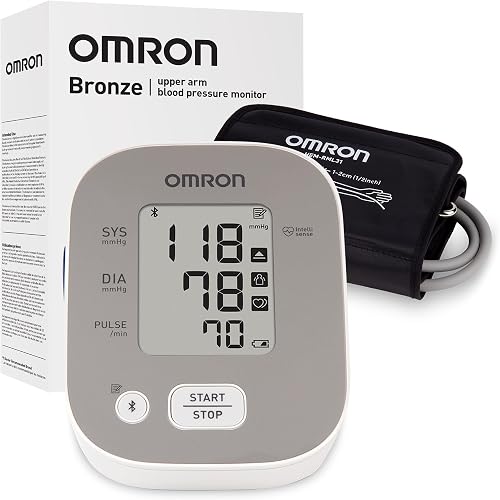
The OMRON Bronze BP5150 is the more feature-focused upper arm alternative. It stores up to 14 readings, detects irregular heartbeats during routine blood pressure measurements, shows a hypertension indicator and connects by Bluetooth to the OMRON connect app.
OMRON Bronze Blood Pressure Monitor & Upper: Best for connected upper arm tracking
- Advanced Accuracy Technology
- Stores up to 14 readings
- Irregular Heart Beat Detection
- Bluetooth and OMRON connect support
- 9–17 inch cuff
A complete upper arm option for readers who want Bluetooth tracking, a wider cuff and additional reading indicators. It includes the monitor, cuff, case, guides and 4 AA batteries.
Pros
- Bluetooth supports unlimited app storage
- Detects irregular heartbeats during readings
- Includes a 9–17 inch cuff and storage case
Cons
- Stores 14 readings on the monitor
- Uses 4 AA batteries
The BP5150 includes a wide-range D-ring cuff for 9–17 inch arms, a storage case, an instruction manual, a quick start guide and 4 AA batteries. The app can store unlimited readings, track trends and share reports with a doctor, with compatibility for Apple Health and Google Fit.
Those features matter if you want to review patterns instead of writing down every result. They do not make a single reading diagnostic, and an irregular heartbeat indicator should be discussed with a qualified clinician rather than treated as a diagnosis.
Read our Omron Bronze blood pressure monitor reviews for a closer look at this connected upper arm option.
How do you choose between these products?
Choose the Omron 3 Series when you want a straightforward upper arm monitor and do not need app history. The HEM-RML31 is the relevant add-on when your compatible monitor needs a larger 9–17 inch cuff.
Choose the Oklar wrist monitor when portability, voice broadcast and dual-user memory matter more than an upper arm format. Its 240-reading capacity for 2 users is useful for tracking, but careful wrist positioning remains essential.
Choose the Omron Bronze BP5150 when Bluetooth, irregular heartbeat detection and a 9–17 inch cuff are priorities. Its on-device memory is 14 readings, while the connected app provides unlimited storage.
For a higher-tier Omron comparison, see our Omron 10 Series review. It can help you decide whether the 3 Series level has enough tracking and display support for your routine.
How can you get more consistent readings?
Use the same chair, arm position and general time of day when practical. Rest first, keep your back supported, place both feet flat and avoid talking during the measurement.
Take two readings when your care plan calls for repeat checks, leaving at least 5 minutes between them. Record the date, time and readings so you can show a clear pattern rather than relying on memory.
Cuff fit matters as much as the monitor name. A cuff that is too small or too loose can make the process uncomfortable and reduce confidence in the result, so measure your arm and confirm the compatible range.
Set up your space before you start each session. A table at a comfortable height helps you keep the arm supported without lifting it or pressing it into your side.
Avoid common distractions that can change a reading. Eating, caffeine, smoking, bathing and recent exertion can all affect results, so waiting at least 30 minutes after those activities is a sensible habit.
Keep movement to a minimum during inflation. Sitting still, keeping the arm relaxed and staying silent makes it easier to repeat the same conditions at the next check.
Store your notes in one place. A simple notebook or a phone note with date, time and both readings is enough to spot trends over time.
Our guide to using an Omron blood pressure monitor covers the basic setup habits that apply across compatible Omron units.
Can an ECG monitor replace a blood pressure monitor?
An ECG or EKG monitor records the heart's electrical activity, while a blood pressure monitor measures pressure in the arteries. They answer different questions, so one does not replace the other.
An ECG can show rhythm and electrical patterns over a short period. A blood pressure monitor shows how strongly blood presses against artery walls at the moment of measurement.
An ECG monitor cannot tell you your systolic or diastolic pressure. In the same way, a blood pressure monitor cannot provide a full picture of the heart's electrical activity.
This distinction matters when high blood pressure is discussed alongside heart monitoring. High readings relate to pressure, while ECG information relates to electrical signals, and confusing the two can lead to the wrong next step.
Some home devices combine functions, but the underlying measurements remain separate. Always check what a device actually measures before assuming it covers both pressure and electrical activity.
Using both types of information together may be useful when a clinician asks for a fuller picture. Records from each device should be kept clear, with dates and times, so patterns do not get mixed up.
Read Using EKG to Monitor High Blood Pressure for the relationship between the two types of monitoring. You can also review Can an ECG Monitor Detect High Blood Pressure? for the limits of ECG-based information.
If you are unsure which type of monitor suits you, ask a clinician about the purpose of testing. They can explain whether you need pressure readings, rhythm information, or a different form of assessment.
Keep home monitoring in its proper place in your care. Home readings can support a discussion with a clinician, but they do not replace professional advice or emergency care.
Seek medical advice for repeated high readings, symptoms, or questions about medication.
Omron 3 Series blood pressure monitor reviews: final verdict
The Omron 3 Series BP7150 is the best fit for simple upper arm monitoring, provided the cuff matches your arm and your routine does not require app storage. Pick the HEM-RML31 if you need a compatible 9 to 17 inch replacement cuff, the Oklar if portability and voice guidance come first, or the Omron Bronze if Bluetooth tracking and additional indicators matter.
The practical choice comes down to how you want to use the monitor day to day. A straightforward upper arm setup suits readers who prefer a short routine with clear readings and manual notes.
The HEM-RML31 suits a narrower task. It helps when a compatible Omron monitor already works but the cuff size or condition needs attention, and it fits arms from 9 to 17 inches.
The Oklar wrist monitor suits a different routine. Its compact size, rechargeable battery, voice broadcast, and dual user storage may help households that move between rooms or travel with the device.
The Omron Bronze BP5150 suits readers who want more from each upper arm reading. Bluetooth connection to the OMRON connect app, storage for unlimited app readings, and irregular heartbeat detection add tracking options beyond a basic display.
None of these choices removes the need for correct technique. Cuff fit, arm support, quiet rest, and consistent timing matter more than extra features when you want readings that can be compared over time.
For Omron 3 Series blood pressure monitor reviews, the practical decision rule is simple. Choose the basic upper arm setup for straightforward checks, and pay more attention to fit and repeatable technique than to extra features.
Measure your arm, confirm the monitor model, and decide how detailed your records need to be. That approach helps you choose a setup you will use consistently rather than one that looks stronger on paper.
If your needs change, you can move to a connected model without changing the core habit of regular, careful measurement. The right monitor is the one that fits your arm, your routine, and the way you want to share results.
Frequently asked questions
Is the Omron 3 Series BP7150 a good blood pressure monitor?
The Omron 3 Series BP7150 is a sensible entry-level upper arm choice when you want a straightforward home monitor and the cuff fits your arm. Compare it with the Omron Bronze BP5150 if you want Bluetooth tracking, irregular heartbeat detection and a 9–17 inch cuff included.
What cuff fits the Omron 3 Series BP7150?
The Omron HEM-RML31 is a large 9–17 inch replacement cuff for listed Omron 3, 5, 7 and 10 Series monitors, including the BP710N. Confirm your exact model before ordering because the cuff is not compatible with older HEM models or every Omron monitor.
Is an upper arm or wrist blood pressure monitor better?
An upper arm monitor is usually easier to position consistently because the cuff sits on the upper arm, while a wrist monitor is smaller and easier to carry. Whichever style you choose, keep the measuring point at heart level and follow the device instructions for repeatable readings.
Can a blood pressure monitor detect high blood pressure?
A home blood pressure monitor measures blood pressure at a specific time, but one reading does not diagnose a condition. Record readings correctly and discuss repeated high results with a qualified clinician.
An ECG or EKG monitor also does not replace a blood pressure monitor for measuring pressure.