Is an ECG Smartwatch as Accurate as a Real ECG?
On this page (5 sections)
Yes, an ECG smartwatch can be surprisingly accurate for detecting certain heart rhythm issues, but it’s not a replacement for a clinical electrocardiogram (ECG). These devices are great for screening and tracking, but they have limitations compared to a hospital-grade ECG.
You might wonder if your smartwatch can truly keep tabs on your heart. We found that while these gadgets offer convenient health monitoring, they aren’t designed for diagnosing complex heart conditions. Think of them as a helpful friend, not a doctor in your pocket, for early warning signs.
- ECG smartwatches can detect common arrhythmias like atrial fibrillation (AFib).
- They are not as comprehensive as a 12-lead clinical ECG.
- Smartwatch ECGs are best for screening and personal health tracking. To learn more about what features are important, consider our guide on what to look for in a good home ECG monitor.
- Always consult a doctor for diagnosis and treatment.
- They offer peace of mind and can prompt earlier medical attention.
Ready to understand the real score? Let’s dive into the details of how ECG smartwatches stack up against traditional ECGs, and what that means for your heart health.
Smartwatch ECGs vs. Clinical ECGs: A Head-to-Head Comparison
You’re curious about how your sleek new smartwatch stacks up against the medical equipment at your doctor’s office. Let’s break it down. We’ll look at their differences, what they do well, and where they fall short. This will help you understand their roles in monitoring your heart health.
What Exactly Is an ECG?
An electrocardiogram (ECG or EKG) is a test that records the electrical signals in your heart. These signals make your heart beat. Doctors use ECGs to check your heart’s rhythm and electrical activity.
The Science Behind Heart Signals
Every heartbeat starts with an electrical impulse. This impulse causes your heart muscles to contract. An ECG machine picks up these tiny electrical changes on your skin. It then plots them on a graph, showing waves and spikes.
Understanding the Clinical ECG (12-Lead)
When you go to a clinic or hospital for an ECG, they usually perform a 12-lead ECG. This is the gold standard for heart monitoring. It gives doctors a very detailed view of your heart’s electrical activity.
How a Clinical ECG Works
For a 12-lead ECG, technicians place 10 electrodes on specific spots on your chest, arms, and legs. Each electrode acts like a camera, recording electrical activity from a different angle. This creates 12 distinct “views” of your heart. These multiple views allow doctors to pinpoint issues like heart attacks, blocked arteries, or complex rhythm problems. It’s like getting a full 360-degree picture of your heart (American Heart Association).
How Do Smartwatch ECGs Function?
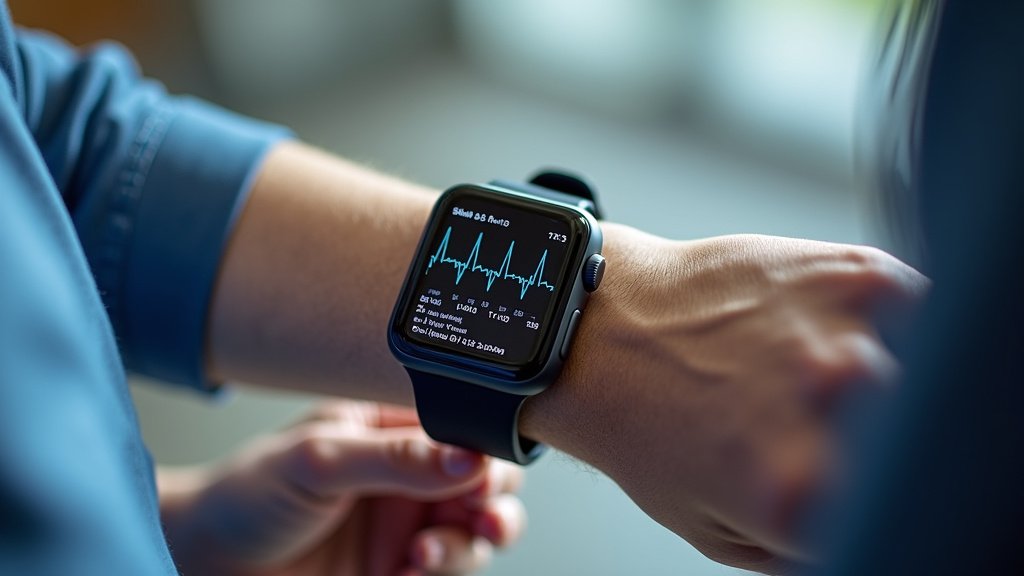
Smartwatch ECGs are much simpler. They typically use two electrodes. One is usually on the back of the watch, touching your wrist. The other is often on the crown or bezel, which you touch with a finger from your other hand. This creates a “lead I” ECG, measuring the electrical signal between your two arms.
The Single-Lead Advantage
Because smartwatches only use one lead (or sometimes two, depending on the model), they can’t provide the same detailed information as a 12-lead ECG. However, this single-lead capability is still very useful. It’s good at detecting rhythm problems, especially atrial fibrillation (AFib), which is a common type of irregular heartbeat (Mayo Clinic).
We found that many smartwatch ECGs are FDA-cleared. This means the Food and Drug Administration has reviewed them and determined they are safe and effective for their intended use. This clearance applies to detecting AFib or normal sinus rhythm, not for diagnosing all heart conditions.
Accuracy Face-Off: Smartwatch ECGs vs. Clinical ECGs
So, how close do smartwatches come to the real deal? It’s a question many people ask. The answer depends on what you’re trying to measure and why.
Accuracy in Detecting Atrial Fibrillation (AFib)
For detecting atrial fibrillation, smartwatch ECGs show impressive accuracy. Studies have shown that some devices have a sensitivity of over 90% and a specificity of over 95% for AFib. This means they are very good at identifying AFib when it’s present and also good at ruling it out when it’s not (National Institutes of Health). This makes them a valuable tool for early screening.
Limitations in AFib Detection
However, it’s important to remember that they are not perfect. Smartwatches might miss some subtle forms of AFib or other less common arrhythmias. They can also produce “inconclusive” results if the signal isn’t clear, often due to movement or poor contact. They don’t give you a diagnosis; they give you a warning sign.
Beyond AFib: Where Smartwatches Fall Short
While excellent for AFib, smartwatch ECGs are not designed to detect other serious heart conditions. For example, they cannot reliably diagnose a heart attack, structural heart disease, or complex arrhythmias like ventricular tachycardia. This is because they only provide a single view of the heart’s electrical activity, not the comprehensive picture a 12-lead ECG offers.
The Diagnostic Gap
Think of it like this: a smartwatch ECG is like looking at a house through one window. You can see if the lights are on, or if someone is moving inside. A 12-lead ECG is like walking around the entire house, looking through every window, and even going inside. You get a much fuller understanding of what’s happening. That’s why doctors still rely on clinical ECGs for a complete diagnosis.
Here’s a quick comparison:
| Feature | Smartwatch ECG | Clinical ECG (12-Lead) |
|---|---|---|
| Number of Leads | 1 (or 2) | 12 |
| Detected Conditions | Primarily Atrial Fibrillation (AFib), normal rhythm | AFib, heart attack, structural issues, complex arrhythmias, electrolyte imbalances |
| Purpose | Screening, personal monitoring, early warning | Diagnosis, detailed assessment, treatment planning |
| Accessibility | Convenient, on-demand | Requires medical visit |
| Data Detail | Basic rhythm strip | Comprehensive electrical activity map |
| Medical Standard | FDA-cleared for specific uses | Gold standard for cardiac diagnosis |
Using Your ECG Smartwatch Wisely: A Practical Guide
Now that you know the differences, how can you make the most of your ECG smartwatch? It’s about using it as a tool, not as a replacement for professional medical care.
When Your Smartwatch Can Be Most Helpful
Your smartwatch ECG is a fantastic tool for personal health awareness. It can give you peace of mind between doctor visits. If you feel palpitations or an irregular heartbeat, taking an ECG reading on your watch can provide useful data for your doctor.
It’s also particularly useful for individuals who are at higher risk for AFib. This includes older adults or those with certain health conditions. Regular monitoring can help detect AFib earlier, allowing for quicker treatment. Early detection and treatment of AFib can reduce the risk of stroke.
When to Seek Professional Medical Attention
This is crucial: your smartwatch is not a diagnostic device. If your smartwatch alerts you to a potential issue, or if you feel unwell, it’s time to call your doctor. Don’t wait. Many experts say that unexplained chest pain, shortness of breath, dizziness, or fainting always warrant a medical evaluation, regardless of your smartwatch reading.
Your doctor can review your smartwatch data alongside other clinical information. They will then decide if further testing, like a 12-lead ECG or a Holter monitor, is needed. Always trust your doctor for diagnosis and treatment plans.
Important Checklist for Smartwatch ECG Users:
- Always share unusual readings with your doctor.
- Don’t self-diagnose based on watch results alone.
- Understand your watch’s limitations.
- Seek immediate medical help for severe symptoms.
- Use it as a screening tool, not a diagnostic one.
- Maintain good watch contact for accurate readings.
The Future of Wearable ECG Technology
The technology behind ECG smartwatches is constantly improving. We can expect even more sophisticated features and greater accuracy in the coming years. Researchers are always looking for ways to expand what these devices can monitor. This could include detecting other heart conditions or providing more detailed insights.
However, the fundamental principle remains: wearables will likely continue to support, not replace, traditional medical diagnostics. They’ll be your first line of defense, prompting you to seek professional care when needed. We’re excited to see how these tools continue to help people stay on top of their heart health.
Conclusion
Your ECG smartwatch is a powerful personal health tool, offering impressive accuracy for detecting conditions like AFib. We’ve seen it acts as an excellent early warning system and screening device. However, it’s vital to remember that it doesn’t replace the detailed diagnostic capabilities of a clinical 12-lead ECG. Always use your smartwatch data as information to share with your doctor, not for self-diagnosis. If your watch alerts you to an issue, or if you feel unwell, contact your healthcare provider promptly. Your well-being is always the priority, and professional medical advice is key for accurate heart health management.
Frequently Asked Questions
Can a smartwatch ECG detect a heart attack?
No, a smartwatch ECG cannot reliably detect a heart attack. These devices primarily look for heart rhythm irregularities, like AFib. A heart attack requires a more comprehensive clinical ECG and other medical tests for accurate diagnosis.
How often should I use my smartwatch ECG?
You can use your smartwatch ECG as often as you feel necessary, especially if you experience symptoms like palpitations or dizziness. For general monitoring, checking it periodically or when prompted by your device can be helpful. Always discuss your monitoring frequency with your doctor.
What does an “inconclusive” smartwatch ECG reading mean?
An “inconclusive” reading usually means the smartwatch couldn’t get a clear enough signal to classify your heart rhythm. This can happen due to movement, poor contact between your skin and the electrodes, or sometimes, a rhythm that the device can’t interpret. Try taking another reading while still and relaxed.
Do all smartwatches have ECG capabilities?
No, not all smartwatches have ECG capabilities. This feature is typically found on higher-end models from major brands. If ECG monitoring is important to you, check the product specifications carefully before purchasing your smartwatch.
Should I stop taking my heart medication if my smartwatch ECG shows a normal rhythm?
Absolutely not. You should never stop or change your prescribed heart medication based solely on smartwatch readings. Your treatment plan is determined by your doctor based on a full medical evaluation. Always consult your doctor before making any changes to your medication.