9 Best Blood Pressure Monitors with Small Cuffs (November 2026)
The best blood pressure monitors with small cuffs include the iHealth Track Smart Upper Arm Blood Pressure for most smaller adults, the OMRON Iron Blood Pressure Monitor & Upper for a simple upper-arm setup, and the Paramed Blood Pressure Monitor for two-user memory.
On this page (9 sections)
- The best blood pressure monitors with small cuffs
- How we chose the best blood pressure monitor with small cuff
- What cuff size do smaller adults need?
- Upper-arm versus wrist monitors for small arms
- How to get more consistent home readings
- Choosing memory, display and power features
- Do small cuffs work with every blood pressure monitor?
- Can an ECG monitor replace a blood pressure monitor?
- Which small-cuff monitor should you choose?
The iHealth Track Smart Upper Arm Blood Pressure Monitor is the best blood pressure monitor with small cuff needs for most adults because its wide-range cuff starts at 8.7 inches.
It suits smaller adults who want a standard upper-arm routine without moving to a wrist device. The cuff range reaches to 16.5 inches, so it also covers many average arms in the same household.
Your arm measurement matters more than the monitor's overall size. Measure around the middle of your upper arm before choosing, then match that number to the cuff's stated range.
A cuff that is too large can feel loose and harder to place in the same spot each time. A cuff that is too small will not wrap properly at all, so the lower end of the range matters most here.
The iHealth Track also keeps day to day use simple. It uses two buttons, shows results on a large multi-color backlit display, and stores up to 99 readings on the device.
Its display uses green, yellow and red coding to show whether a reading is optimal or not. That color cue can help at a glance, while the numbers remain there for a closer look.
For tracking over time, the monitor works with free iOS and Android apps and allows unlimited readings on a smartphone. That setup suits people who like to review patterns rather than rely only on memory.
It can also alert you to heart rhythm disturbances after a measurement. That alert is useful information to note, but it works best alongside your regular routine and any guidance you already follow.
For a broader look at monitor types, read our best blood pressure monitor guide. If your arm is below the usual adult range, our guide to the best blood pressure monitor for small adults covers the sizing decision in more detail.
Measure first, then choose the format you can position most consistently. That simple order will save time and make home readings easier to compare.
Our picks at a glance
-
1
 Best for most smaller adults
iHealth Track Smart Upper Arm Blood Pressure
9.7/10 our score
See it on Amazon -
2
 Best for a simple upper-arm setup
OMRON Iron Blood Pressure Monitor & Upper
9.7/10 our score
See it on Amazon -
3

- 4
 Check it
MMIZOO Wrist Blood Pressure Monitor BP Machine
Best for portable wrist readings - 5
 Check it
rihaory Child Small Cuff Compatible with Most
Best for very small upper arms - 6
 Check it
Oklar Wrist Blood Pressure Monitor
Best for rechargeable wrist use - 7
 Check it
Oklar FDA Cleared Blood Pressure Monitor Upper
Best for upper-arm storage - 8
 Check it
Sinocare Blood Pressure Monitor
Best for dual-user home tracking - 9
 Check it
ATUDER Blood Pressure Monitors for Home Use
Best for three-reading averages
The best blood pressure monitors with small cuffs
These are the strongest options for smaller arms, based on cuff range, positioning needs, memory, display design and power choices. The list is built for shoppers who need to know what fits before they think about extra features.
Our score weighs specs, features and buyer feedback against what you are shopping for. It does not replace your own arm measurement or your usual home routine.
The order below keeps upper-arm and wrist models separate for clarity. That separation helps you compare fit, storage and setup without mixing two different routines.
Each entry focuses on practical details for smaller adults. Cuff range comes first, followed by the features that affect regular home use.
Upper-arm models suit people who can wear the cuff on the upper arm and keep it at heart level. They also suit households that want a familiar seated routine from one check to the next.
Wrist models suit people whose upper arm is too small for the listed cuff range. They also suit people who need a more portable device for a bedside table, bag or small shelf.
Memory matters when you check often or share a device. Some models store readings for one person, while others keep separate profiles for two users.
Display design matters in low light or when you want to read the result without getting up. Large numbers and backlighting can make morning and evening checks easier.
Power choices affect daily habits more than the box suggests. Included batteries simplify the first setup, while a rechargeable design can reduce routine battery changes.
Use the cuff range as the first filter for every entry. A long feature list does not help if the cuff cannot wrap your arm in its stated range.
Then compare positioning, memory, display and power in that order. That order keeps the choice tied to daily use rather than general interest in a device.
If two models share a similar cuff range, pick the one whose controls and storage match your habits. Simple operation often matters more during a quiet daily check than extra settings.
iHealth Track Smart Upper Arm Blood Pressure: Best for most smaller adults
- 8.7 to 16.5 in wide-range cuff
- Stores up to 99 readings
- iOS and Android app support
- Heart rhythm disturbance alert
The wide-range cuff starts at 8.7 inches and the large backlit display keeps readings easy to see. App support adds unlimited smartphone tracking.
Pros
- Smallest upper-arm fit among the main monitors here
- Large color backlit display
- Batteries and cuff included
Cons
- Wrist models take less upper-arm space
- App requires a compatible phone and Bluetooth 4.0
OMRON Iron Blood Pressure Monitor & Upper: Best for a simple upper-arm setup
- 9 to 17 in wide-range cuff
- One-touch operation
- Irregular heartbeat detection
- Body movement detection
A one-button design and movement alerts make this a straightforward upper-arm option. Its cuff starts at 9 inches, so measure carefully if your arm is below that point.
Pros
- Simple one-touch operation
- Movement detection
- Wide-range cuff included
Cons
- Does not fit arms below 9 inches
- Batteries are required
Paramed Blood Pressure Monitor: Best for two-user memory
- 8.7 to 16.5 in adjustable cuff
- 120 readings for 2 users
- Large LCD and buttons
- Voice broadcast
The self-checking cuff starts at 8.7 inches and supports two user profiles. Large controls and optional voice broadcast suit households with different reading needs.
Pros
- Two-user memory
- Self-checking cuff
- Carrying bag included
Cons
- Voice feature may not suit every room
- AC adapter is not included
MMIZOO Wrist Blood Pressure Monitor BP Machine: Best for portable wrist readings
- Wrist design
- 2 users with 99 measurements each
- Large LCD and voice broadcast
- Carrying case included
This wrist monitor is compact and stores 99 measurements for each of 2 users. It needs careful wrist positioning at heart level and does not include batteries.
Pros
- Compact wrist format
- Two-user memory
- Carrying case included
Cons
- Batteries are not included
- Wrist position affects readings
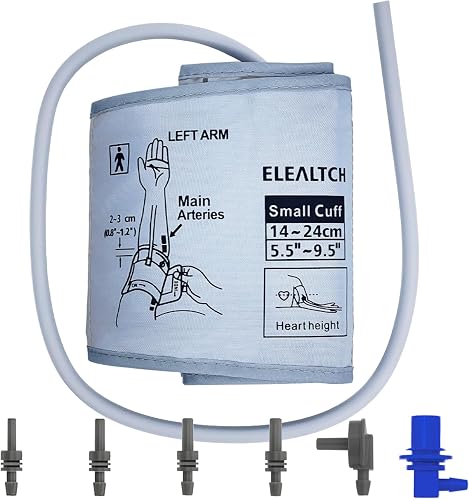
rihaory Child Small Cuff Compatible with Most: Best for very small upper arms
- 5.5 to 9.5 in stated fit
- Nylon cuff fabric
- TPU airbag
- Six connector sizes included
This replacement cuff is the right size-focused choice for arms below most adult monitor ranges. It is a cuff only, so you need a compatible blood pressure monitor.
Pros
- Smallest arm range here
- Six connectors included
- Adjustable nylon cuff
Cons
- Monitor is not included
- Connector fit must be checked
Oklar Wrist Blood Pressure Monitor: Best for rechargeable wrist use
- 4.92 to 8.46 in adjustable wrist cuff
- 240 readings for 2 users
- Built-in rechargeable battery
- Type-C cable included
The adjustable wrist cuff fits smaller wrists and the rechargeable battery avoids routine battery replacement. Its large LED display and voice broadcast support easier reading.
Pros
- Small wrist fit
- Large two-user memory
- Rechargeable design
Cons
- Charging adapter is not included
- Wrist must stay at heart level
Oklar FDA Cleared Blood Pressure Monitor Upper: Best for upper-arm storage
- 8.7 to 15.7 in upper-arm cuff
- 240 readings for 2 users
- One-button operation
- Battery or Type-C power
This upper-arm model combines an 8.7-inch starting point with 240 total memory slots. It runs from 3 AA batteries or the Type-C cable, but the cable does not recharge batteries.
Pros
- Two-user memory
- Large backlit display
- Two power options
Cons
- Batteries are not included
- Not rechargeable
Sinocare Blood Pressure Monitor: Best for dual-user home tracking
- 8.6 to 16.5 in adjustable cuff
- 99 readings for each of 2 users
- 3.6 in screen
- Posture and irregular-heartbeat alerts
The cuff starts at 8.6 inches, making it one of the better upper-arm fits for smaller adults. Dual-user memory and a large screen support regular home tracking.
Pros
- Small 8.6-inch starting range
- Two-user memory
- Batteries included
Cons
- Type-C cable is not included
- Upper-arm cuff still needs accurate positioning
ATUDER Blood Pressure Monitors for Home Use: Best for three-reading averages
- 8.7 to 15.7 in cuff
- 240 records for 2 users
- Large backlight display
- Three consecutive readings
ATUDER stores 120 readings for each of 2 users and takes 3 consecutive readings for an average. Its cuff starts at 8.7 inches and includes a carrying case.
Pros
- Three-reading average
- Two-user memory
- Carrying case included
Cons
- Largest and heaviest unit in this group
- Cuff does not fit below 8.7 inches
How we chose the best blood pressure monitor with small cuff
The first filter was fit. An upper-arm cuff that starts at 8.6 or 8.7 inches gives smaller adults more room than one that begins at 9 inches, while the rihaory replacement cuff reaches 5.5 inches.
That lower starting point is useful only if it matches your measured arm. A small adult can still fall below 8.6 inches, so we kept the smallest cuff option in the group.
The second filter was daily use. Large displays, simple buttons, user memory, voice prompts and power options can matter as much as the cuff range when you take readings often.
A display that is easy to read in low light suits evening checks. Large buttons and clear controls suit anyone who wants a short routine without extra steps.
We also looked at how readings are stored. Single-user memory may be enough for one person, while two-user memory helps when partners or family members share a device.
Two-user storage also makes trends easier to discuss. It keeps each person's history separate instead of mixing readings from different arms and routines.
We also separated upper-arm and wrist designs. Wrist monitors can fit smaller wrists and take less space, but they require more careful heart-level positioning.
Upper-arm models generally place the cuff in a familiar spot. They still need correct placement, but many people find that position easier to repeat.
Wrist models suit situations where an upper-arm cuff does not fit or is not practical. Their trade-off is stricter positioning during each measurement.
Read our guide to how to choose a blood pressure monitor with a small cuff before deciding between the two formats.
Use that guide with your own arm measurement in hand. The right choice is the one you can use correctly and consistently at home.
| Product | Best for | Cuff range | Memory | Power | Our score |
|---|---|---|---|---|---|
| iHealth Track Smart Upper Arm Blood Pressure | most smaller adults | 8.7 to 16.5 in | Up to 99 readings | 4 AAA batteries included | 9.7 |
| OMRON Iron Blood Pressure Monitor & Upper | a simple upper-arm setup | 9 to 17 in | 4 AA batteries required | 9.7 | |
| Paramed Blood Pressure Monitor | two-user memory | 8.7 to 16.5 in | 120 readings for 2 users | 4 AAA batteries required | 9.6 |
| MMIZOO Wrist Blood Pressure Monitor BP Machine | portable wrist readings | 99 measurements per user | 2 AAA batteries required | 9.6 | |
| rihaory Child Small Cuff Compatible with Most | very small upper arms | 9.6 | |||
| Oklar Wrist Blood Pressure Monitor | rechargeable wrist use | 240 readings for 2 users | Built-in rechargeable battery | 9.5 | |
| Oklar FDA Cleared Blood Pressure Monitor Upper | upper-arm storage | 8.7 to 15.7 in | 120 readings per user | 3 AA batteries or Type-C cable | 9.3 |
| Sinocare Blood Pressure Monitor | dual-user home tracking | 8.6 to 16.5 in | 99 readings per user | 4 AAA batteries included | 9.1 |
| ATUDER Blood Pressure Monitors for Home Use | three-reading averages | 8.7 to 15.7 in | 120 readings per user | 4 AAA batteries included | 8.7 |
What cuff size do smaller adults need?
Most of the upper-arm monitors here start between 8.6 and 8.7 inches, but that does not mean every small adult will fit them.
Measure the arm at the center of the bicep, not around the forearm or near the elbow.
That midpoint is the area the cuff needs to wrap. Measuring elsewhere can give a number that looks suitable but does not match the cuff range.
Keep the tape level and snug without pressing into the skin. Take the measurement before you buy, and write it down for comparison.
The rihaory cuff is the smallest option in this group, with a stated 5.5 to 9.5 inch range. It is a replacement cuff, not a complete monitor, and its connector must match your device.
That distinction matters for budgeting and setup. You will still need a compatible monitor, and you should check the connector before you rely on the cuff.
The OMRON Iron starts at 9 inches. It may suit a small adult whose upper arm measures at least 9 inches, but it is not the best choice for an arm below that point.
Its simple one-touch operation is appealing for an upper-arm routine. Fit still comes first, because a simpler control does not fix a cuff that starts above your arm size.
For more OMRON sizing help, see how to choose the right OMRON blood pressure monitor cuff size.
If your arm sits near a boundary, consider how the cuff will sit in practice. A range that only just includes your measurement may still need careful placement each time.
Upper-arm versus wrist monitors for small arms
Upper-arm monitors are often easier to compare from one reading to the next when the cuff fits. The iHealth Track, Paramed, Oklar upper-arm, Sinocare and ATUDER models all start at 8.6 or 8.7 inches.
That shared starting point makes them suitable for many smaller adults. It does not cover every arm, so your measurement still decides whether an upper-arm model is practical.
Upper-arm placement also follows a familiar pattern. The cuff wraps around the arm and sits at heart level, which many people can repeat with the same arm support.
Wrist monitors solve a different problem. The MMIZOO uses a wrist format with 99 measurements for each of 2 users, while the rechargeable Oklar wrist model fits wrists from 4.92 to 8.46 inches and stores 240 readings for 2 users.
A wrist format can suit a smaller wrist when an upper-arm cuff is too large. It can also suit travel or storage in a small space.
Wrist placement is less forgiving. Wear the cuff as directed, keep the wrist at heart level, stay quiet and still, and use the same wrist each time.
Small shifts in height or angle can change the setup from one check to the next. Using the same wrist and supporting the arm helps keep that setup consistent.
If you cannot keep that position, an upper-arm model with the correct cuff may be easier to use.
Think about where you will measure most often. A chair, table and quiet few minutes at home will support either format, but the format must match your habits.
How to get more consistent home readings
Take measurements under similar conditions so changes are easier to compare. Sit quietly for about 5 minutes, keep both feet flat, support your back and place the cuffed arm at heart level.
That short rest period helps settle the routine before the cuff inflates. It also makes it easier to repeat the same setup at the same time each day.
Avoid talking or moving during the measurement. If your monitor allows multiple readings, follow its instructions for the interval between readings instead of taking them back to back without a pause.
Staying still also helps the monitor detect the signal cleanly. Movement alerts, where fitted, are a reminder to repeat the check under calmer conditions.
Cuff placement also matters. The rihaory instructions place the lower edge about 0.8 to 1.2 inches above the elbow, with the artery area aligned correctly and enough room to place one finger under the cuff.
That finger gap helps the cuff sit snug without being overly tight. It gives you a simple check before you press start.
Keep the cuff at the same level as your heart during the reading. A table or arm support can help, especially for wrist models that need steady positioning.
Keep a record that includes the date, time, reading and which monitor you used. A stored history can help you discuss patterns with a health professional, but a monitor alert is not a diagnosis.
Notes about your routine can be just as useful as the numbers. Similar timing, seating and cuff placement help you spot real patterns instead of changes caused by setup.
Choosing memory, display and power features
Pick a large backlit display if you need to read numbers in low light. The iHealth Track, Paramed, MMIZOO, rechargeable Oklar and upper-arm Oklar models all emphasize large or backlit displays.
A large display is especially helpful for morning or evening checks. It also helps when you want to read the result without moving closer to the monitor.
Two-user memory helps when more than one person uses the monitor. The Paramed stores 120 readings across 2 profiles, while the Oklar upper-arm model stores 120 readings per user.
Separate profiles keep each person's readings easy to find. That matters more when two people measure at different times or follow different routines.
ATUDER also stores 120 readings per user and takes 3 consecutive readings for an average.
An average from consecutive readings can give a steadier reference for home tracking. It still works best when each reading uses the same seated position and cuff placement.
Power choices vary. iHealth includes 4 AAA batteries, Sinocare includes 4 AAA batteries, and the ATUDER includes 4 AAA batteries.
Included batteries make the first setup simple. You can start using the monitor without a separate purchase, then keep spares ready for replacement.
The rechargeable Oklar wrist model has a built-in battery and Type-C cable, but its charging adapter is not included.
That design reduces routine battery changes for regular use. You will need a compatible adapter for charging, so check what you already have at home.
The upper-arm Oklar model can use 3 AA batteries or its Type-C cable. It is not rechargeable, and the cable powers the monitor rather than charging batteries.
That dual option can suit a bedside table or travel. Just remember to use one power method at a time and follow the instructions for each.
Do small cuffs work with every blood pressure monitor?
No. A small cuff must fit your arm and connect correctly to the monitor.
The right arm size alone does not make a replacement cuff safe or suitable for every device.
Fit covers both the wrap around your arm and the tube connection to the device. A cuff can be the right size for your arm and still be unsuitable if the connector does not match.
The rihaory cuff includes 4 mm, 4.6 mm, 5 mm, 6 mm, 7 mm, and 11.3 mm connectors, but you still need to confirm the connector and cuff design work with your device. Those sizes cover several common fittings, yet they are a starting point for checking rather than a promise of universal fit.
Those connector sizes give you options for different monitors. They do not guarantee compatibility with every model, so check your monitor before ordering.
Start by finding your monitor model and comparing its connector with the options supplied. Remove the old connector if the design allows it, then test the new cuff for a secure fit before you rely on it.
Do not force a connector or use a cuff that sits outside its size range. An incorrect fit can affect the reading and make it harder to compare results over time.
A loose connection can also affect inflation. If the cuff will not attach securely, it is safer to stop and find the correct match.
Arm placement matters as well as the connector. Keep the lower edge about 0.8 to 1.2 inches above the elbow and align the artery area correctly.
Leave enough room to place one finger under the cuff. That gap helps you check that the cuff is snug without squeezing the arm.
Keep the cuff at the same level as your heart during the reading. A table or arm support can make that position easier to repeat.
If you need a replacement rather than a new monitor, see our guide to the best blood pressure monitor replacement cuff.
That guide can help you separate a cuff problem from a monitor problem. A damaged cuff may need replacing even when the monitor still works.
Replace a damaged cuff, and pay attention to air-leak warnings or visible wear. Fraying, cracks or a cuff that no longer holds its shape can affect inflation.
A cleaning wipe with a damp cloth and soapy water is listed for the rihaory cuff, with disinfection by wiping with 70% ethanol. Let the cuff dry fully before the next use.
Store the cuff in a clean and dry place when you are not using it. That simple habit can reduce wear and help you spot damage before the next check.
Do not share a cuff that does not fit your arm just because it fits the monitor. Compatibility has to cover the arm, the connector and the placement routine together.
If your arm is near the edge of the stated range, measure again before you order. A small change in placement can make a borderline fit harder to repeat.
When in doubt, choose the cuff and monitor combination that you can position the same way each time. Consistent placement is more useful than forcing a close match.
Can an ECG monitor replace a blood pressure monitor?
No. An ECG or EKG records electrical activity from the heart, while a blood pressure monitor measures pressure in the arteries.
Those are different measurements with different purposes.
One does not replace the other, even when both relate to heart health. You can use one device for blood pressure readings and still need separate care for heartbeat concerns.
Some monitors in this roundup can flag irregular heartbeats, but that feature does not turn them into ECG devices. The alert appears during a blood pressure check and points to a pattern in the heartbeat signal.
An irregular heartbeat alert during a blood pressure check is a prompt to note the result. It is not the same as a full recording of electrical activity.
That distinction helps you read your records more clearly. A blood pressure monitor gives pressure numbers for home tracking, while an ECG records electrical timing and rhythm in a different way.
Our guide to using EKG to monitor high blood pressure explains how the measurements differ. It can help you avoid treating one reading as if it answers the other question.
You can also read can an ECG monitor detect high blood pressure for a clearer explanation of what each device can and cannot show. That question comes up often because both devices are linked to heart health.
Use a blood pressure monitor for blood pressure readings at home. Keep any heartbeat alerts in context when you review your records.
Record the date, time and result when an alert appears. A short note about your routine can make the record easier to discuss later.
Do not let an alert replace your usual follow-up routine. If you have concerns about repeated alerts, seek medical advice rather than changing your care based on one device alone.
Do not use an ECG reading as a substitute for regular blood pressure checks. High blood pressure can be present without a clear heartbeat pattern showing on another type of device.
Likewise, do not expect a blood pressure monitor to give the full picture of heart rhythm. Its alert is limited to the measurement it is taking at that moment.
For home use, the practical choice is to track blood pressure with the right cuff and a repeatable routine. That gives you comparable readings over time.
If heartbeat alerts appear often, note them calmly and keep your blood pressure records separate. Clear records make later conversations more useful than mixed readings from different devices.
Which small-cuff monitor should you choose?
Choose the iHealth Track if you want the strongest all-around upper-arm option with an 8.7 to 16.5 inch cuff, a large display, 99-device memory and smartphone tracking.
It suits most smaller adults who fit the cuff range and want app tracking. Its color-coded display also makes the result easier to read at a glance.
Choose the rihaory replacement cuff if your arm is below the usual adult monitor range and your current device accepts a compatible connector.
That choice keeps your existing monitor in use. Check the connector sizes and cuff placement before you place an order.
Choose the rechargeable Oklar wrist monitor if a 4.92 to 8.46 inch wrist fit and portable power matter more than upper-arm positioning.
It suits people who can keep the wrist at heart level and prefer a rechargeable design. Its two-user memory also helps with shared home tracking.
For two users, the Paramed, upper-arm Oklar, Sinocare and ATUDER all offer useful memory.
Those models differ in display, power and cuff range. Compare each starting point with your measured arm before you narrow the list.
For the simplest setup, compare the one-button upper-arm models with the fit of your measured arm before ordering.
Measure once, then choose the format you can repeat with confidence. That is the most practical way to pick a small-cuff monitor for home use.
Our top 3 picks at a glance
-
1
Best for most smaller adults
iHealth Track Smart Upper Arm Blood Pressure
9.7/10 our score
See it on Amazon -
2
Best for a simple upper-arm setup
OMRON Iron Blood Pressure Monitor & Upper
9.7/10 our score
See it on Amazon -
3
Frequently asked questions
What is the best blood pressure monitor with small cuff?
The iHealth Track is the best blood pressure monitor with small cuff needs for most adults because its upper-arm cuff fits 8.7 to 16.5 inch arms. The Sinocare starts at 8.6 inches, while the rihaory replacement cuff reaches smaller 5.5 to 9.5 inch arms when it fits your monitor.
How do I know if a blood pressure cuff is too big?
Measure around the middle of your upper arm, then compare that number with the cuff range. A cuff that cannot sit securely within its stated range may affect readings.
If your arm is below 8.6 or 8.7 inches, look for a smaller cuff or ask a clinician about a suitable monitor.
Are wrist blood pressure monitors good for small adults?
Wrist monitors can suit small adults when an upper-arm cuff is too large, but position matters more. Keep the wrist at heart level, stay still and silent, and use the same wrist each time.
An upper-arm monitor is usually easier to position consistently when its cuff fits.
Can I use a replacement small cuff on any monitor?
No. A replacement cuff must fit both your arm and the monitor's connector.
The rihaory cuff includes six connector sizes and is designed for most brands, but you should compare the connector before use.
Do not use a cuff that cannot attach securely or sit correctly.
How should I measure blood pressure at home?
Sit quietly for about 5 minutes with your feet flat and your back supported. Keep the cuffed arm at heart level, avoid talking, and take readings under similar conditions.
The American Heart Association gives additional guidance on measuring blood pressure at home.


