Omron Blood Pressure Monitor Cuff Size Guide
Choose an Omron cuff by measuring your upper arm and matching that measurement to a cuff approved for your exact monitor model. A large cuff is not automatically compatible with every Omron device.
On this page (10 sections)
- How do you measure for an Omron blood pressure monitor cuff?
- Which Omron monitors work with the HEM-RML31 large cuff?
- How does an Omron blood pressure monitor with a large cuff compare with a wide-range monitor?
- What is a good alternative to an Omron large cuff?
- Can a blood pressure monitor with a small cuff fit better?
- Is a wide-range cuff better than a replacement cuff?
- How should you put on a large blood pressure cuff?
- What should you check before buying an Omron extra large cuff?
- When should you replace an Omron blood pressure cuff?
- Which option should you choose?
The right Omron blood pressure monitor cuff size depends on your upper-arm circumference and your monitor model. Measure your arm first, then choose a cuff whose range includes that measurement and whose compatibility list includes your device.
This order matters because a cuff can look large enough in a photo and still fail in daily use. The printed circumference range tells you what arm it is designed to wrap around, while the model list tells you what monitor it is designed to work with.
A large cuff is useful only when it fits your arm and connects correctly. The Omron HEM-RML31 covers 9-17 in arms, but its compatibility is limited to named Omron models.
Starting with the word large alone can lead to a poor fit. A smaller arm in a large cuff can sit loosely, and a larger arm may not close securely, so the label should never replace a measurement.
For people who already own a compatible Omron monitor, a replacement cuff can be the simplest path. It keeps placement, posture, and recording familiar over time.
For people without a compatible monitor, a complete device with a wide-range cuff may be more practical. That route lets you judge cuff, display, memory, and app features together.
Measure your bare upper arm at the middle, with the tape flat and not pressing into the skin. Keep the arm relaxed and write the result down before comparing it with any product range.
Use the same arm and a similar position each time you measure. Do not measure over a sleeve, since fabric can change the result.
If the result falls near the edge of a range, measure again on another day under similar conditions. A small error near a limit can push you toward the wrong cuff.
Then find the exact model number printed on your monitor. Do not rely on the series name alone, because the HEM-RML31 is listed for 7 Series Advanced and 10 Series Advanced models and is not compatible with older HEM models.
This guide focuses on the HEM-RML31 as the direct large-cuff option for those named Omron models. It also compares wide-range complete monitors for readers who need a different starting point.
For complete devices, our best blood pressure monitor guide explains choices for upper-arm monitors, cuff fit, and home tracking. Use it to decide whether you need a replacement part or a new system, then return to your arm measurement and monitor model.
How do you measure for an Omron blood pressure monitor cuff?
Measure around the middle of your bare upper arm, using a flexible tape that lies flat without pressing into your skin. Keep your arm relaxed while you take the measurement.
Record the circumference in inches or centimeters. If your measurement is close to a cuff's limit, measure again to reduce the chance of choosing the wrong size.
A cuff range is not the same as the monitor's outside dimensions. It describes the upper-arm circumference the cuff is designed to wrap around.
Use the same arm and a similar position each time you measure. Do not measure over a sleeve, since fabric can change the result.
What upper-arm measurement needs a large cuff?
The Omron HEM-RML31 large cuff fits upper arms measuring 9–17 in. That range is the key starting point for anyone searching for an Omron blood pressure monitor large cuff.
If your arm measures below 9 in, look for a small cuff that covers your measurement. If it measures above 17 in, do not assume the HEM-RML31 will fit securely.
Search for a larger compatible cuff or a different monitor system.
The cuff should sit snugly but comfortably. You should follow the monitor's manual for placement, tubing position and measurement posture.
For a wider discussion of large-cuff devices, see our guide to the best large cuff blood pressure monitor.
Which Omron monitors work with the HEM-RML31 large cuff?
The HEM-RML31 is compatible with the Omron 7 Series Advanced and 10 Series Advanced models named in its title. The listed models include BP742N, BP786, BP785N, BP761 and BP710N.
It is not compatible with older HEM models. That warning matters because two Omron monitors can look similar while using different cuff connections or compatibility requirements.
Check the model number printed on the monitor before buying a replacement. If your model is not named in the compatibility information, confirm the match with Omron before using the cuff.
Why does monitor compatibility matter?
A cuff is part of the measurement system, not just a fabric sleeve. The connector, tubing and monitor settings must work together for the cuff to operate as intended.
The HEM-RML31 has a preformed, expandable firm arm cuff. Its title identifies it as a large 9–17 in cuff for specific Omron BP monitor families.
Do not choose it only because you need a large cuff. First match the arm range, then match the monitor model.
How does an Omron blood pressure monitor with a large cuff compare with a wide-range monitor?
A replacement large cuff keeps a compatible monitor in use, while a wide-range monitor can offer a cuff that covers many arm sizes from the start. The better choice depends on whether you already own a compatible Omron device.
The HEM-RML31 makes sense when your current monitor is one of the listed 7 Series Advanced or 10 Series Advanced models. It can also be a practical choice when the existing monitor already fits your routine and only the cuff needs replacing.
Its main limitation is compatibility. It is not a universal Omron cuff, and it is not marked for older HEM models.
Read our best blood pressure monitor replacement cuff guide if you are deciding between a model-specific replacement and a new monitor with a different cuff range.
A complete monitor may be easier when your current device is not compatible or when more than one person in the household needs a different arm range.
What is a good alternative to an Omron large cuff?
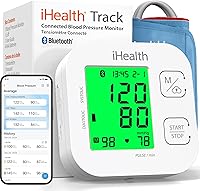
A wide-range upper-arm monitor can suit you if you want the cuff included with the device rather than buying a model-specific replacement. The iHealth Track includes a wide-range cuff for upper arms measuring 8.7–16.5 in.
The iHealth Track uses an upper-arm cuff and has a large, multi-color backlit display with oversized numbers. Its two-button operation is aimed at simple setup and readings.
It stores up to 99 readings on the monitor. The iHealth applications for iOS and Android can store unlimited readings, with iOS 12.0 or later, Android 9.0 or later and Bluetooth 4.0 or later required for the app connection.
The monitor automatically identifies heart rhythm disturbances and displays a warning symbol after the measurement if one is detected. That indicator does not diagnose a heart condition.
The package includes the monitor, 4 AAA batteries, the wide-range cuff, an instruction manual and a 12-month warranty. iHealth says the monitor meets ESH 2010 performance standards.
The cuff range starts below the HEM-RML31's 9 in minimum but ends at 16.5 in rather than 17 in. Compare the actual measurement range with your arm before choosing between the two.
Can a blood pressure monitor with a small cuff fit better?
A small cuff can fit better when your upper-arm circumference falls below the range of a standard or large cuff. You should choose by measurement, not by the label alone.
For smaller arms, compare devices and replacement cuffs that publish a range covering your measurement. Our guide to the best blood pressure monitor with small cuff focuses on complete monitors, while our bp monitor with small cuff guide explains the fitting process.
Do not use a large cuff simply because it is easier to find. A cuff that does not match your arm can sit incorrectly and make consistent readings harder.
If several people use one monitor, record each person's arm measurement. One cuff may not be the right fit for everyone.
Is a wide-range cuff better than a replacement cuff?
A wide-range cuff is more convenient when you are buying a complete monitor, while a replacement cuff is often the simpler choice when your existing monitor is compatible. Neither option is automatically better for every arm.
The Greater Goods Bluetooth Blood Pressure Monitor includes an adjustable upper-arm cuff covering 8.7–16.5 in. Its product information also says smaller or larger cuff options are available through Greater Goods support for people who need a different fit.
The monitor measures systolic and diastolic pressure and tracks pulse rate. It includes irregular heartbeat detection, which displays an indicator when an irregular pulse pattern is detected during measurement.
That indicator does not diagnose a heart condition.
Bluetooth connects it with the Balance Health app on iOS and Android. The app can store unlimited readings, show averages and trends, export reports and share results with a doctor.
The monitor also stores up to 60 readings per user, or 120 total, with or without Bluetooth.
A large backlit display, bold numbers and one-touch operation support routine readings. The cuff has an artery alignment guide to help with placement.
The package includes the digital monitor, adjustable upper-arm cuff, portable travel case, 4 AAA batteries and an AC adapter. Greater Goods also says smaller and larger cuff options are available through its support team.
This monitor may suit a household that wants built-in tracking rather than a replacement cuff for an existing Omron device. It is not an Omron-compatible replacement for the HEM-RML31.
How should you put on a large blood pressure cuff?
Place the cuff on your bare upper arm, with the lower edge and artery alignment mark positioned according to the monitor's instructions. Keep the cuff snug, with enough room to slide one finger underneath.
Sit quietly with your back supported and your feet flat. Rest your arm so the cuff is around heart level, and avoid talking during the measurement.
Use the same arm and a similar routine when tracking changes over time. Blood pressure can vary with activity, posture and stress, so a single reading does not show your usual pattern.
Wait at least 3 minutes between readings if you need to repeat one. Follow the manual for any additional instructions from your monitor.
An irregular heartbeat symbol is an alert about the pulse pattern detected during that measurement. It is not a diagnosis, so discuss repeated or concerning results with a health professional.
What should you check before buying an Omron extra large cuff?
Before searching for an Omron blood pressure monitor extra large cuff, write down your arm measurement and the exact model number of your monitor. Then check whether the cuff range extends beyond the 9–17 in range of the HEM-RML31.
Search terms such as blood pressure monitor large cuff Omron and Omron blood pressure monitor with large cuff can help you find the right product type, but they do not confirm compatibility by themselves.
Use this checklist:
- Measure the middle of your bare upper arm.
- Record the measurement in inches.
- Find the monitor's exact model number.
- Compare your measurement with the cuff's stated range.
- Confirm that the cuff is approved for your model family.
- Check whether the cuff is a replacement or comes with a complete monitor.
- Follow the manual for placement and use.
If your arm is outside the HEM-RML31 range, do not stretch the cuff to make it work. Look for another compatible size or choose a complete monitor with a published range that covers your measurement.
When should you replace an Omron blood pressure cuff?
Replace a cuff when it no longer fits securely, the fabric or tubing is damaged, the connector does not hold properly, or the cuff cannot be positioned as directed. Use a replacement made for your monitor model.
These signs matter because a cuff is part of the measurement system, not just a sleeve around your arm. If it will not wrap, seal, or connect as intended, readings taken with it are harder to trust or compare.
Check fit first when a cuff starts to feel wrong. The closure should sit snugly and comfortably on your bare upper arm, positioned according to the monitor instructions.
Look at the outer fabric for fraying, thinning, or worn areas. A cuff that has stretched over time may wrap less evenly than it did when new.
Inspect the tubing for kinks, cracks, or sharp bends that could affect inflation. Store the cuff without sharply folding the tubing, and keep it clean and dry between uses.
Check the connector each time you attach it. It should fit firmly in the monitor port without force, and it should not loosen during setup or measurement.
Pay attention to the bladder and inner lining if you can see or feel them through the fabric. Uneven inflation can occur when internal parts shift, so a cuff that feels lumpy or uneven may need replacement.
Do not keep using a cuff simply because it still inflates. The practical test is whether it can be placed correctly, held securely, and used in the same way each time.
A replacement cuff should match both your arm circumference and your device. The HEM-RML31 is model-specific, not a general-purpose cuff for every Omron monitor.
Before ordering, confirm that your arm falls within the 9-17 in range and that your monitor is one of the listed 7 Series Advanced or 10 Series Advanced models. A correct size for the wrong model is still the wrong cuff.
Keep the cuff clean and dry, and store it without sharply folding the tubing. Follow Omron's care instructions for the exact cuff, including guidance on cleaning products and drying.
Avoid leaving the cuff in a hot car, a damp bathroom, or a bag where the tubing can be pressed flat for long periods. Simple storage habits can protect the fabric, tubing, and connector.
Which option should you choose?
Choose the Omron HEM-RML31 if you own a listed Omron 7 Series Advanced or 10 Series Advanced monitor and your upper arm measures 9-17 in. That match covers both the fit and the connection, which are the two requirements that matter most.
If those conditions are met, the HEM-RML31 is the direct replacement route. It suits a household that wants to keep a familiar monitor in use and only change the part that no longer fits or works well.
Choose the iHealth Track if you want a complete upper-arm monitor with a wide-range 8.7-16.5 in cuff, oversized display, and app tracking. Its two-button operation and large multi-color backlit display are aimed at simple daily readings.
The iHealth Track stores up to 99 readings on the monitor, with unlimited readings in the free iOS and Android apps where the stated system and Bluetooth requirements are met. It also alerts to heart rhythm disturbances during measurement, which is an indicator rather than a diagnosis.
Choose the Greater Goods Bluetooth monitor if you want an 8.7-16.5 in cuff plus app trends, report sharing, and built-in memory. It stores up to 60 readings per user, or 120 total, with or without a Bluetooth connection.
That monitor also includes an artery alignment guide, one-touch operation, a large backlit display, and irregular heartbeat detection. The package includes a travel case and an AC adapter, which can help at home and when traveling.
Do not choose between these options by cuff label alone. Compare your actual upper-arm measurement with the stated range, and confirm whether you need a replacement cuff or a complete monitor.
For an Omron owner, the deciding question is model compatibility, since the HEM-RML31 is not compatible with older HEM models. For a new buyer, the deciding question is which complete system fits your arm and your tracking routine.
The key rule for an Omron blood pressure monitor large cuff is simple: measure your arm, verify the model, then check the cuff range before ordering. For related heart monitoring questions, see Using EKG to Monitor High Blood Pressure and How to Choose the Right ECG Monitor?.
The Greater Goods monitor is for buyers who want trends and sharing from a complete system, while the HEM-RML31 remains the choice only for owners of listed Omron models in the 9-17 in range. Pick the option that matches both your measurement and your current device.
Frequently asked questions
What size is the Omron HEM-RML31 cuff?
The Omron HEM-RML31 is a large cuff for upper arms measuring 9–17 in. It is compatible with the Omron 7 Series Advanced and 10 Series Advanced models named in its product title, including BP742N, BP786, BP785N, BP761 and BP710N.
Check your monitor model before ordering.
How do I know if I need an Omron blood pressure monitor large cuff?
Measure around the middle of your bare upper arm, then compare the result with the cuff's printed range. The HEM-RML31 fits 9–17 in arms.
If your arm is outside that range, look for a different cuff size or a monitor with a wider cuff range.
Can I use an Omron cuff on any blood pressure monitor?
No. Cuffs use model-specific connectors and compatibility lists.
The Omron HEM-RML31 is marked for named Omron models and is not compatible with older HEM models.
Match the cuff to both your arm circumference and the exact monitor model.
What happens if a blood pressure cuff is too small?
A cuff that is too small may not wrap correctly around your arm and can affect the reading. A cuff that is too large can also fit poorly.
Use the size range printed for the cuff, place it on your bare upper arm as directed, and follow the monitor's instructions for consistent measurements.