9 Best Smart Heart Blood Pressure Monitors (November 2026)
The best smart heart blood pressure monitors include the OMRON Gold Wireless Wrist Blood Pressure Monitor for morning tracking, the Oklar Wrist Blood Pressure Monitor for voice guidance, and the Dario Gen-2 Blood Pressure Monitor for Home for app sharing.
On this page (7 sections)
- How the best smart heart blood pressure monitors were compared
- Which cuff style fits your arm best?
- How accurate should you expect home readings to be?
- Do you need app sync or is on-device memory enough?
- Cuff vs smartwatch: which heart tracking do you actually need?
- How do you take a reliable reading at home?
- Verdict: which smart heart blood pressure monitor should you buy?
The best smart heart blood pressure monitors split into two groups: cuff monitors that measure pressure directly, and wrist trackers that watch heart trends all day. Our top picks are cuff monitors because they give you a dated reading to share.
Our score weighs specs, features and buyer feedback against what you're shopping for. We checked sizes, memory, power and app features for each model below.
Start with our blood pressure monitor buying guide if you haven't compared cuff styles yet. Measure your wrist or upper arm before you order, because fit changes every reading.
Fit is not a minor detail here. A cuff that is too loose or too tight can shift systolic and diastolic numbers by a wide margin.
That is why every product below lists a circumference range in inches.
Daily routine also matters. Some people will actually take a reading every morning if the device is light and ready.
Others want a one-button check with no phone involved. The right pick depends on that habit.
Our picks at a glance
-
1
 Best for morning tracking
OMRON Gold Wireless Wrist Blood Pressure Monitor
9.5/10 our score
See it on Amazon -
2

-
3

- 4
 Check it
AILE FDA Cleared Blood Pressure Monitor
Best for simple one-touch use - 5
 Check it
Oklar FDA Cleared Blood Pressure Monitor Upper Arm
Best for tight spaces - 6
 Check it
FITVII Health & Fitness Tracker
Best for 24/7 wellness trends - 7
 Check it
Sinocare Blood Pressure Monitor
Best for posture alerts - 8
 Check it
MorePro Fitness Tracker with 24/7 Heart Rate
Best for activity plus heart data - 9
 Best for calls on your wristCheck it
How the best smart heart blood pressure monitors were compared
Upper arm monitors cover most homes, while wrist monitors win on portability. App sync matters if you share trends, and dual user memory matters for couples.
Smartwatches track heart data all day but don't replace a cuff.
We compared cuff circumference, memory per user, power source, display size, and whether readings sync to an app. We also separated FDA cleared cuff monitors from wellness trackers that are not for medical use.
Heart features were compared in detail. Irregular heartbeat detection, morning average indicators, posture alerts, and color coded level indicators all help you interpret a reading.
Voice broadcast helps a different group of users who struggle with small digits.
Price was not used as a shortcut. A lower cost model can still suit a home if cuff fit and memory are right.
A higher cost wrist model can still be a poor choice if you cannot keep your wrist at heart level.
What we left out and why
We left out fingertip devices and chest straps because they do not measure blood pressure with a cuff. We also left out models with no stated cuff range, since fit cannot be verified before you buy.
That focus keeps the list useful for home monitoring. If you only want step counting, a basic activity tracker would do.
If you want a dated pressure reading for your doctor, you need one of the cuff models here.
| Product | Best for | Cuff fit | Memory | Power | Our score |
|---|---|---|---|---|---|
| OMRON Gold Wireless Wrist Blood Pressure Monitor | morning tracking | Wrist 5.3-8.5 in | 200 readings per user | 2 AAA batteries included | 9.5 |
| Oklar Wrist Blood Pressure Monitor | voice guidance | Wrist 4.92-8.46 in | 240 readings total | Rechargeable lithium ion | 9.5 |
| Dario Gen-2 Blood Pressure Monitor for Home | app sharing | Upper arm 8.75-16.5 in | Second on-device user profile | 4 AAA batteries included | 9.4 |
| AILE FDA Cleared Blood Pressure Monitor | simple one-touch use | Upper arm 8.7-16.5 in | 99 readings per user | 4 AAA batteries | 9.3 |
| Oklar FDA Cleared Blood Pressure Monitor Upper Arm | tight spaces | Upper arm 8.7-15.7 in | 120 readings per user | 3 AA batteries, not included | 9.3 |
| FITVII Health & Fitness Tracker | 24/7 wellness trends | 9.3 | |||
| Sinocare Blood Pressure Monitor | posture alerts | Upper arm 8.6-16.5 in | 99 readings per user | 4 AAA batteries included | 9.1 |
| MorePro Fitness Tracker with 24/7 Heart Rate | activity plus heart data | 8.8 | |||
| FTTMWTAG Smart Watch | calls on your wrist | 8.2 |
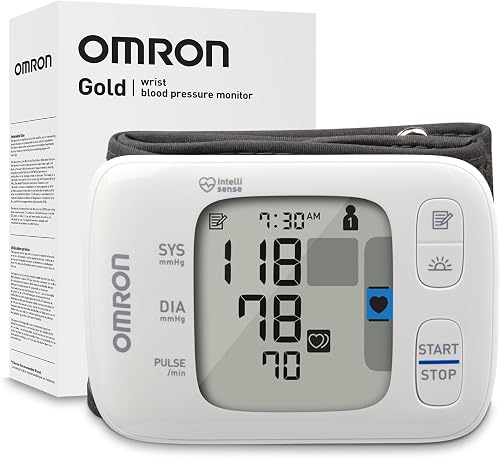
OMRON Gold Wireless Wrist Blood Pressure Monitor: Best for morning tracking
- Wrist cuff fits 5.3 to 8.5 in
- Stores 200 readings per user
- Bluetooth with OMRON connect app
- Irregular heartbeat detection
A wrist monitor with a morning average indicator and app sync for sharing trends with your doctor.
Pros
- Dual user memory
- Bluetooth app sync
- Morning average indicator
Cons
- Wrist position affects readings
- Needs heart-level placement
OMRON Gold suits people who want a morning routine with clear feedback and a record to share. Its High Morning Average Indicator flags when morning readings rise above normal over time.
That helps you spot patterns instead of reacting to one number on one day.
The wrist cuff fits wrists from 5.3 to 8.5 inches and stores 200 readings for each of two users. Two AAA batteries are included, and the unit weighs 3.17 ounces at 3.58 by 0.52 by 2.49 inches.
Bluetooth sync sends unlimited readings to the free OMRON connect app. You can track trends, share reports with your doctor, and use Apple Health and Google Fit.
Irregular heartbeat detection runs during each measurement to flag rhythm concerns.
Its trade-off is wrist position. You must keep the cuff at heart level and stay still, or readings can drift.
Choose it for app sharing and morning tracking, and pick an upper arm model if wrist placement feels hard to repeat daily.
Oklar Wrist Blood Pressure Monitor: Best for voice guidance
- Wrist cuff fits 4.92 to 8.46 in
- Stores 240 readings for two users
- Rechargeable with Type-C cable
- Voice broadcast and LED display
A rechargeable wrist monitor with voice prompts and a large backlit display for low-light use.
Pros
- Voice broadcast
- Rechargeable battery
- Large LED display
Cons
- Charging adapter not included
- Wrist monitor, not upper arm
Oklar Wrist suits users who want spoken results and no battery swaps. Its voice broadcast reads results aloud, and you can adjust volume or turn sound off with the SET and MEM buttons.
That helps if small digits are hard to read.
The cuff fits wrists from 4.92 to 8.46 inches and stores 240 readings across two users. It measures in about 35 seconds, and a large LED backlit display keeps numbers clear in low light.
Power comes from a built-in rechargeable battery charged with a Type-C cable. No charging adapter is included, so use a compatible 5V 1A charger.
The device turns off after 60 seconds without use, which helps preserve charge between days.
Its trade-off is the wrist form factor and charging setup. Keep the same wrist each time, sit quietly for 5 minutes, and hold the cuff at heart level.
Choose it for voice guidance and rechargeable use, and choose upper arm if you prefer that cuff style.
Dario Gen-2 Blood Pressure Monitor for Home: Best for app sharing
- Upper arm cuff fits 8.75 to 16.5 in
- Bluetooth Dario app sync
- Irregular heartbeat detection
- Carry case included
An upper arm monitor with app sync, a color coded level indicator and a carry case for travel.
Pros
- Upper arm cuff
- App trend tracking
- Carry case included
Cons
- Battery powered only
- No AC adapter included
Dario Gen-2 suits buyers who want upper arm measurement plus app sharing. Its adjustable cuff fits upper arms from 8.75 to 16.5 inches.
Measure midway between shoulder and elbow before you order, and place the cuff about 1 inch above the elbow with two fingers fitting under it.
The large backlit display shows systolic, diastolic and pulse. Bluetooth sync sends User 1 readings to the Dario app for trends and sharing with your doctor or family.
A second on-device profile supports another user, though app sync is described for User 1 only.
Irregular heartbeat detection flags pulse irregularities during a reading. A color coded indicator shows blood pressure level at a glance.
The kit includes batteries and a carrying case, and the unit runs on 4 AAA batteries at 9.95 ounces.
Its trade-off is power and portability. It is not rechargeable and has no AC adapter.
Choose it for upper arm checks with app trends, and pick a wrist model if you want a smaller unit for travel.
AILE FDA Cleared Blood Pressure Monitor: Best for simple one-touch use
- Upper arm cuff fits 8.7 to 16.5 in
- 99 readings per user for two users
- One-touch automatic measurement
- 4 AAA batteries with external power option
A simple upper arm monitor with one-touch operation and large digits for everyday home checks.
Pros
- One-touch operation
- Large display
- Dual user memory
Cons
- No app sync described
- Batteries not listed as included
AILE suits shoppers who want simple upper arm checks without an app. Its one-touch operation inflates, measures and shows systolic, diastolic and pulse on one screen.
The large display uses big, clear digits that are easy to read at arm length.
The adjustable cuff fits arms from 8.7 to 16.5 inches. Dual user memory stores 99 readings per user, 198 in total, with date and time.
Select your user before measuring, then review past readings on the device whenever you need a quick check.
It runs on 4 AAA batteries and supports an external power option. At 13.4 ounces, it is light enough for a drawer or travel bag.
The size is 5.5 by 3.8 by 2.7 inches, so it stores easily in a nightstand.
Its trade-off is limited sharing. There is no app sync described, so you review history on the monitor itself and may need to write numbers down.
Choose it for simple home use and dual user memory, and choose Dario if you want Bluetooth trend sharing.
Oklar FDA Cleared Blood Pressure Monitor Upper Arm: Best for tight spaces
- Upper arm cuff fits 8.7 to 15.7 in
- 120 readings per user for two users
- 3 AA batteries or Type-C power
- One-button design
A compact upper arm monitor with dual power options and a backlit display for small homes.
Pros
- Compact size
- Dual power options
- One-button use
Cons
- Batteries not included
- Not rechargeable
Oklar Upper Arm suits small homes and travel kits. Its compact size is 4.96 by 3.34 by 1.1 inches and it weighs 5.28 ounces.
That makes it easy to store in a drawer or bag, and it is lighter than most upper arm models in this roundup.
The cuff fits upper arms from 8.7 to 15.7 inches. One-button operation starts a measurement, and readings appear within 1 minute on a large backlit LED display.
It stores 120 readings per user for two users, which covers months of morning checks.
Power is flexible: use 3 AA batteries or a Type-C interface. The Type-C cable powers the device only and does not charge batteries.
Note that batteries are not included, and the unit is not rechargeable, so plan for replacements.
Its trade-off is cuff range. Arms wider than 15.7 inches will not fit well, even though other models here go to 16.5 inches.
Choose it for compact upper arm checks, and pick the AILE or Dario if you need a wider cuff.
FITVII Health & Fitness Tracker: Best for 24/7 wellness trends
- 24/7 heart rate and blood pressure tracking
- Sleep and blood oxygen tracking
- 120+ sport modes
- IP67 water resistant
A smartwatch style tracker for heart rate, sleep, activity and blood pressure trends, not for medical use.
Pros
- 24/7 tracking
- Sleep tracking
- Long battery life
Cons
- Not for medical use
- Wrist sensor, not a cuff
FITVII suits people who want all-day heart and activity trends from one wrist device. It tracks heart rate and blood pressure 24/7, plus sleep and blood oxygen.
That full-day view helps you see how rest and activity relate to your heart data over time.
It also tracks steps, calories and distance, with over 120 sport modes. Bluetooth calls, texts and app notifications come to your wrist, and you get sedentary and water reminders.
It is IP67 water resistant for rain and workouts, but not for diving or surfing.
Battery life is up to 7 days, or over 15 days in power-saving mode. It syncs with Android 7 and iOS 13 and above, and fits wrist sizes from 5.71 to 8.86 inches.
The band is 22 millimeters wide in thermoplastic polyurethane.
Its trade-off is key: FITVII says this is for a healthy lifestyle, not for medical use. Choose it for wellness trends and daily activity, and choose a cuff monitor for direct home blood pressure readings you share with your doctor.
Sinocare Blood Pressure Monitor: Best for posture alerts
- Upper arm cuff fits 8.6 to 16.5 in
- 99 readings per user for two users
- 3.6-inch display
- Color coded level indicator
An upper arm monitor with posture detection, irregular heartbeat alerts and a large display.
Pros
- Posture detection
- Large display
- Dual user mode
Cons
- No cable included
- Type-C power is not charging
Sinocare suits families who want clear feedback during each check. Its posture detection alerts you when your position could affect a reading.
A color coded indicator classifies blood pressure level, and it alerts you to irregular heartbeats during measurement.
The cuff fits arms from 8.6 to 16.5 inches, starting slightly lower than most rivals. Dual user mode stores 99 readings per user, so two people can compare historical data without sharing one log.
The 3.6-inch screen shows readings in large digits for easy reading.
Power comes from 4 AAA batteries, which are included, or a Type-C port for temporary power. No charger or cable is included, and Type-C power does not charge the batteries.
Cuff pressure accuracy is listed as plus or minus 3 mmHg and pulse within plus or minus 5%.
Its trade-off is power flexibility without a cable in the box. Choose it for posture alerts and a large display, and pick Dario if you want app sync for sharing trends with family.
MorePro Fitness Tracker with 24/7 Heart Rate: Best for activity plus heart data
- 24/7 heart rate and blood pressure monitoring
- Blood oxygen and sleep tracking
- 120+ sport modes
- IP68 waterproof
A fitness tracker that pairs heart, blood pressure, oxygen and sleep trends with workout tracking.
Pros
- All-day activity tracking
- Sleep stages
- IP68 waterproof
Cons
- Not for medical use
- No GPS
MorePro suits active users who want workouts and heart trends in one tracker. It offers 24/7 heart rate and blood pressure monitoring, plus on-demand blood oxygen checks.
Sleep tracking covers deep sleep, light sleep and wake-ups for a fuller nightly picture.
All-day activity tracking records steps, distance, calories, heart rate and training time. It has over 120 sport modes, menstrual cycle tracking, and reminders to move and drink water.
The IP68 design handles sweat, rain and hand-washing with ease.
It charges in about 2 hours and lasts up to 7 days, or 15 days on standby. It works with Android 7 and above and iOS 13 and above, and it weighs 1.12 ounces with a 230 mAh battery.
Over 200 watch faces let you change the look.
Its trade-off is medical scope. MorePro says this is to inspire a healthy life, not for medical use, and it has no GPS.
Choose it for fitness plus wellness trends, and choose a cuff monitor for direct pressure readings.
FTTMWTAG Smart Watch: Best for calls on your wrist
- 1.85-inch HD touchscreen
- Bluetooth calls and message alerts
- Heart rate, SpO2 and sleep tracking
- 100+ sports modes
A large-screen smartwatch with calls, notifications and fitness tracking for daily wear.
Pros
- Large touchscreen
- Bluetooth calls
- Many watch faces
Cons
- Wellness tracking only
- Heavier than a basic tracker
FTTMWTAG suits people who want calls and notifications on a large wrist screen. Its 1.85-inch HD touchscreen is easy to read, and Bluetooth lets you answer or make calls from the watch.
Message alerts cover social apps and texts while your phone stays in a pocket.
It tracks steps, distance, calories, heart rate, stress and sleep quality. Over 100 sports modes support running and other workouts.
Extra tools include weather, music control, sedentary reminders, stopwatch, alarm and timer for daily use.
It works with Android and iPhone, and you can download over 100 watch faces through the Da fit app. The battery is 290 mAh, and GPS comes via your smartphone rather than a built-in chip.
The band is silicone and 10.23 inches long.
Its trade-off is weight and scope. At 0.12 kg, it is heavier than a slim tracker, and its health data is for daily wellness, not a cuff reading.
Choose it for a call-ready smartwatch, and pick a cuff monitor for home blood pressure checks.
Which cuff style fits your arm best?
Upper arm is the usual choice for home checks. It matches the cuff style used in many clinics and is easier to place at heart level.
Wrist monitors are smaller, but placement matters more.
Upper arm options in this roundup
Dario, AILE, Oklar Upper Arm and Sinocare all use upper arm cuffs. Ranges run from 8.6 to 16.5 inches, except Oklar Upper Arm, which tops out at 15.7 inches.
Measure midway between shoulder and elbow and check the range before you order.
Wrist options in this roundup
OMRON Gold and Oklar Wrist use wrist cuffs. OMRON fits 5.3 to 8.5 inches, while Oklar fits 4.92 to 8.46 inches.
Keep the same wrist each time, rest your arm on a table, and stay still during the reading.
If you want brand specific help, our best blood pressure monitor A&D guide and best Braun blood pressure monitor guide compare other cuff brands. Our best Joytech blood pressure monitor guide covers another common home brand.
Arm shape matters as much as circumference. A tapered arm can feel snug at the top and loose at the bottom.
That is why placement about 1 inch above the elbow helps keep the cuff even.
Wrist size also needs a check before you order. Measure around the wrist bone where the cuff will sit.
If your wrist is near the top of a range, consider the other model with more headroom.
How to measure before you buy
Wrap a soft tape around your upper arm midway between shoulder and elbow. Keep it snug but not tight, and note the number in inches.
Compare that number to each cuff range listed above.
For a wrist model, measure the wrist where you plan to wear the cuff. Keep the tape flat and read the number without squeezing.
Write both numbers down so you can compare them at checkout.
How accurate should you expect home readings to be?
Accuracy starts with fit, rest and position, not the screen. Sit quietly for 5 minutes, keep feet flat, and support your arm at heart level.
Avoid caffeine, smoking and exertion for at least 30 minutes before a check.
Movement, stress and time of day can shift results. Doctors often look at averages and trends, not a single reading.
Take pairs, wait a few minutes between them, and log both numbers.
Sinocare lists cuff pressure accuracy of plus or minus 3 mmHg and pulse accuracy within plus or minus 5%. Other brands describe their units as FDA cleared for home use.
Neither claim replaces a check with your doctor if readings run high or low.
Rhythm data can add context. Our guide on Using EKG to Monitor High Blood Pressure explains what an ECG shows, and Can an ECG Monitor Detect High Blood Pressure? answers a common mix-up: an ECG does not measure pressure.
Different devices can give different numbers on the same day. Use one device consistently for your log.
Irregular heartbeat detection flags pulse irregularities during a reading for your doctor, but it does not diagnose a condition by itself.
Do you need app sync or is on-device memory enough?
App sync pays off when you share trends with a doctor or family. Bluetooth models send readings to a phone app, where you can review charts over weeks.
On-device memory is simpler if you just check the last reading at home.
App sync picks
OMRON Gold syncs to the OMRON connect app and works with Apple Health and Google Fit. Dario syncs User 1 readings to the Dario app.
Both help you spot morning spikes, weekday patterns and changes after lifestyle shifts.
Memory-only picks
AILE and Oklar Upper Arm store readings on the device for two users. Sinocare does the same with posture and heartbeat alerts.
These suit buyers who want fewer accounts and a simple routine.
Pick app sync if you travel, share with a care team, or like charts. Pick on-device memory if you want a one-button check with no phone pairing.
Memory size decides how often you need to clear old readings. AILE stores 99 per user, while OMRON Gold stores 200 per user.
Oklar Upper Arm stores 120 per user, and Sinocare stores 99 per user.
For a couple taking morning and evening pairs, 99 readings last only a few weeks. That is fine if you review regularly.
If you want a longer history, a higher memory count or app storage helps.
App sync also helps when you bring data to an appointment. A chart of morning averages over a month is easier to discuss than a notebook with scattered numbers.
Cuff vs smartwatch: which heart tracking do you actually need?
A cuff measures pressure. A smartwatch tracks heart trends.
That one fact should drive your choice.
If your goal is a home blood pressure log, buy a cuff monitor first.
Smartwatches like FITVII, MorePro and FTTMWTAG track heart rate, sleep, activity and estimated blood pressure trends all day. They are useful for habits, workouts and rest.
They do not inflate a cuff, so they do not give the same direct reading.
Many buyers use both: a cuff for morning and evening checks, and a watch for activity and sleep. That split keeps medical readings clear and wellness data easy to see.
Bring cuff readings to your doctor and ask how watch trends fit your plan.
Battery and wear style differ a lot. A cuff is used for a minute or two and then put away.
A smartwatch is worn all day and needs charging every few days.
Water resistance also differs. FITVII is IP67 and MorePro is IP68, which suits rain and workouts.
Neither rating makes a watch suitable for diving or surfing.
How do you take a reliable reading at home?
Use the same steps every time so your numbers compare well. Sit in a chair with back support, feet flat on the floor, and your arm on a table at heart level.
Rest quietly for 5 minutes before you start.
Place the cuff on bare skin, snug but not tight. For upper arm models, keep the cuff about 1 inch above the elbow.
For wrist models, keep the wrist at heart level and palm up.
Stay still and silent during the measurement. Do not talk, move your arm, or check your phone.
Wait at least 3 to 5 minutes before a second reading, then log both.
Keep a simple log with date, time, arm used and any notes. Note stress, caffeine or recent exercise, as those notes help your doctor interpret trends later.
Use the same arm each time, as switching arms can change numbers. Check battery level before readings, since low battery can slow inflation on some models.
Oklar Wrist warns with a blinking battery symbol and a voice prompt when charge is low.
Verdict: which smart heart blood pressure monitor should you buy?
For most homes, start with OMRON Gold for app sharing or Oklar Wrist for voice and rechargeable use. Both track two users and fit daily routines.
Choose Dario Gen-2 if you want upper arm measurement with app trends and a carry case.
Choose AILE for simple one-touch upper arm checks. Choose Oklar Upper Arm for a compact unit, and Sinocare if posture alerts help you.
Add FITVII, MorePro or FTTMWTAG only for all-day wellness trends, not as a cuff replacement.
Measure your arm or wrist first, keep your routine consistent, and share your log with your doctor. That simple plan makes any of these best smart heart blood pressure monitors more useful.
If you share a home with a partner, dual user memory keeps logs separate without extra work. If you travel often, weight and power matter, with Oklar Upper Arm the lightest upper arm model here at 5.28 ounces.
Pair a cuff with a watch if you want both pressure readings and sleep, steps and heart rate trends.
Our top 3 picks at a glance
-
1
Best for morning tracking
OMRON Gold Wireless Wrist Blood Pressure Monitor
9.5/10 our score
See it on Amazon -
2
-
3
Frequently asked questions
Are smartwatch blood pressure readings the same as a cuff monitor?
No. A cuff monitor inflates to measure pressure, while a watch uses wrist sensors to estimate trends.
Use a cuff for home blood pressure checks and discuss trends with your doctor.
Should I choose a wrist or upper arm blood pressure monitor?
Choose upper arm if you want the style most clinics use and you can fit the cuff. Choose wrist only if arm fit is a problem and you can keep the wrist at heart level every time.
How often should I take home blood pressure readings?
Many doctors ask for morning and evening pairs after rest. Take readings at the same time, in the same chair, with the same arm, and bring your log to your next visit.
Can an ECG monitor detect high blood pressure?
No. An ECG shows heart rhythm, not pressure in your arteries.
A cuff monitor measures pressure directly, and rhythm data can add context when you talk with your doctor.


